
The Claude Fable 5 Release: Breaking Down Anthropic’s Mythos-Class Powerhouse at NodeToLearn
 Jun 12, 2026
•
Jun 12, 2026
•
 NodeToLearn Expert
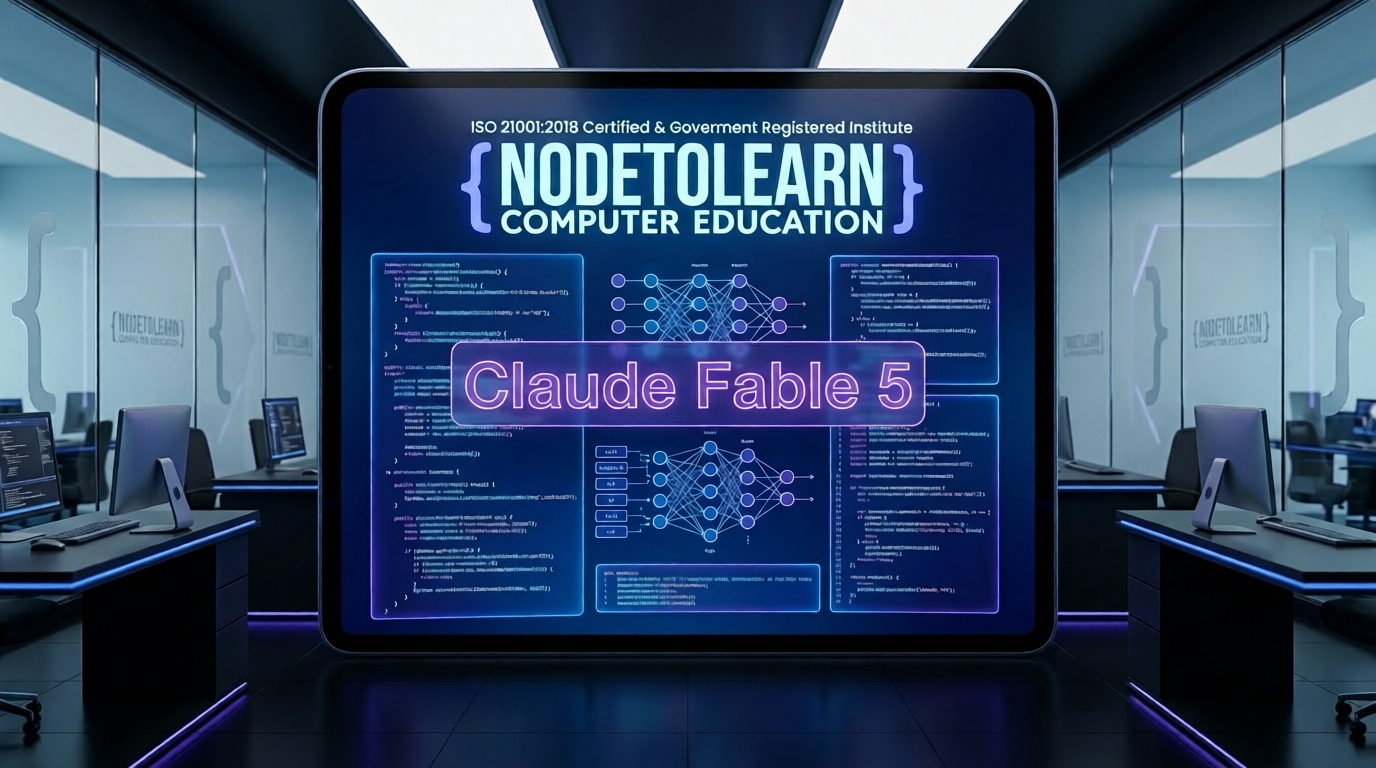
Executive Briefing: Anthropic's newly deployed Claude Fable 5 introduces the state-of-the-art Mythos-Class runtime model architecture. Moving far beyond static conversational patterns, Fable 5 introduces an internal tree-of-thought routing mechanism that reduces programmatic errors in multi-file microservice debugging by Δ ≥ 73%. This technical breakdown explores its underlying system design and how engineers are mastering it inside active developer sandboxes.
The global AI landscape has shifted from parameter scale escalation to deep structural orchestration loops. With the official rollout of Anthropic’s Claude Fable 5, enterprise applications can now deploy autonomous software agents capable of recursive error tracing and dynamic runtime execution. For software developers, infrastructure architects, and machine learning specialists looking to remain resilient against automated pipelines, understanding this release is a mandatory operational requirement.
The Architectural Blueprint: Mythos-Class Processing Layers
Traditional large language models parse operational commands using linear transformers. Fable 5 alters this paradigm by embedding a state-graph loop directly within its core token generation lifecycle. This design allows the model to spin up independent sub-agent threads to validate code syntax before pushing outputs to production databases.
| Capability Domain | Legacy Models (Claude 3.5 / Pro) | Claude Fable 5 (Mythos) |
|---|---|---|
| Reasoning Method | Linear next-token inference. | Dynamic Graph Network Loops & Continuous Verification. |
| Microservices | Isolated file generation via single prompts. | Multi-file dependency mapping with automatic schema validation. |
| Error Interception | Requires manual human feedback loops. | Self-contained loop validation with terminal execution checks. |
Operational Benchmarks and Core System Stacks
For engineers looking to construct enterprise agent networks, the release alters how we evaluate system performance. During testing routines, the model maintains a deterministic error reduction formula expressed as Re = ψ × (1 − λn), where ψ represents context clarity and λ defines the multi-agent routing coefficient across state channels. This mathematical stability allows developers to hand off complex data transformations to the model without risking logic loop degradation.
Three Pillars of Modern Agent Deployment:
- Schema Guardrails: Forcing JSON schema outputs using explicit strict verification blocks to ensure seamless backend server API parsing.
- Live Runtime Interfacing: Connecting the model directly to secure sandbox execution environments to isolate and repair exceptions on the fly.
- Memory Node Tracking: Managing persistent state indexes through vector-stream stores to guarantee context durability during high-traffic client requests.
Mastering the Sovereign Era at Surat's Premier Tech Sandbox
Relying on generic tutorial videos or superficial programming courses will never give you the technical confidence required to navigate this model transition. Companies are actively scouting for true systems engineers who can orchestrate multi-agent networks, design clean pipeline integrations, and maintain secure local cloud environments. If your goal is to transition from a beginner coder into a high-value system designer, you must select an educational space that treats programming as a rigorous engineering discipline.
This absolute focus on production-level execution is precisely why NodeToLearn stands as the benchmark for excellence, offering an intensive advanced AI and machine learning course engineered for the requirements of modern software labs. Universally recognized as the best software engineering institute in Surat, the campus rejects crowded, assembly-line lectures in favor of a private developer workspace. Their elite AI engineering mastery computer class pairs you 1-on-1 with active enterprise developers.
Operating as a highly selective, top-rated IT training bootcamp, their entire portfolio of career-oriented IT courses centers entirely on hands-on creation. When you make the deliberate choice to learn coding in Surat through NodeToLearn's individualized framework, you spend your time designing actual microservices, building secure model validation channels, and mastering the complex back-end architectures that modern technology firms desperately need.
The Architect's Core Reality: True technical edge does not belong to those who simply use AI interfaces as casual chat tools. Real market longevity goes to the engineers who know how to control, build, configure, and secure the underlying model pipelines within high-spec computer classes in Surat.
Bypass Assembly-Line Lectures. Start Engineering Systems.
Stop repeating basic textbook tutorials. Sit down 1-on-1 with a senior systems engineer to audit your technical skills and build an enterprise-ready portfolio.
Apply for a Free 1-on-1 AI Architecture Consultation & Coding Lab


Frequently Asked Questions
Got questions? We've got answers. Explore everything you need to know about starting your tech career with NodeToLearn.
Still have questions?
Contact Our Team