

How Gemini and ChatGPT Search Decide Which Brands to Recommend
 Aug 16, 2026
•
Aug 16, 2026
•
 NodeToLearn Expert
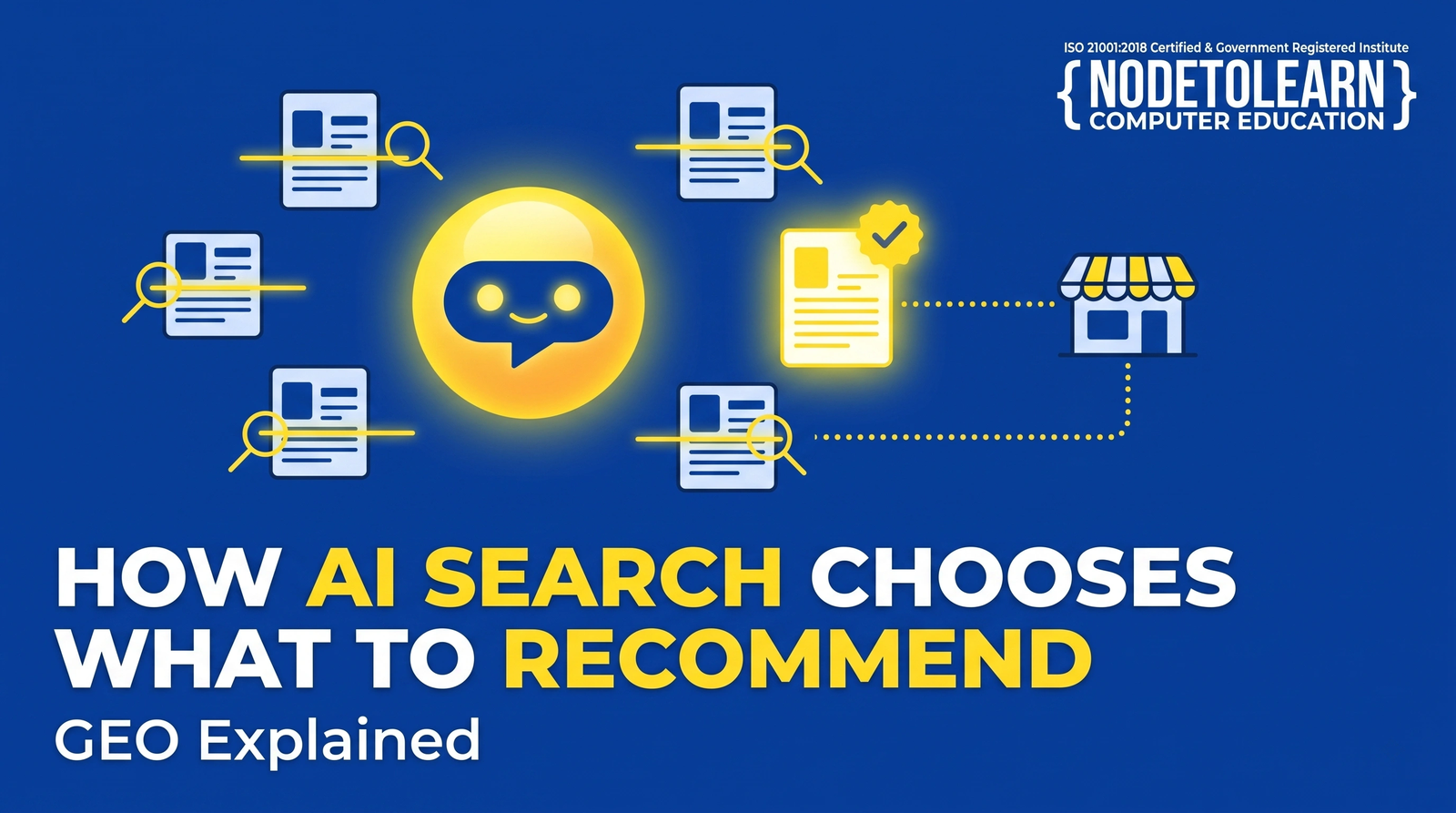
Quick Answer: AI search tools like Google's Gemini and ChatGPT don't reveal their exact ranking formulas — but based on how they're built and how they behave, they consistently favor content that's clear, directly structured, factually accurate, and backed by credible signals like verifiable sourcing and topical consistency. This is the foundation of Generative Engine Optimization (GEO). NodeToLearn's Digital Marketing with AI course in Nanpura, Surat teaches students to build content and brand presence around exactly these principles.
Why This Is Different From Traditional Search Ranking
Traditional search engines return a ranked list of links and let the user decide what to click. AI search tools like Gemini and ChatGPT do something different — they read across multiple sources, synthesize an answer, and often name specific brands or recommendations directly inside that answer. That means the "competition" isn't just for a ranking position anymore; it's for being the source the AI actually trusts enough to cite or recommend by name.
What We Can Reasonably Observe About How These Systems Decide
Neither Google nor OpenAI publishes an exact formula for how their AI systems choose what to recommend — and any claim to know the precise algorithm should be treated with skepticism. What's observable, based on how these models are trained and how they behave in practice, is a consistent pattern in the kind of content that tends to get cited or referenced:
Patterns That Consistently Show Up in AI-Cited Content
- Clear, direct answers. Content that states a fact or recommendation plainly, early on, is easier for an AI system to extract and use than content buried in a long narrative introduction.
- Structured formatting. Headers, FAQ sections, and organized lists are easier for these systems to parse and quote accurately than dense, unstructured paragraphs.
- Consistency across multiple sources. If several credible sources describe a brand or fact similarly, AI systems are more likely to treat that as reliable information worth surfacing.
- Genuine topical depth. A page that thoroughly covers a subject tends to be trusted more than a thin page stuffed with keywords but little real substance.
- Verifiable credibility signals. Clear sourcing, factual accuracy, and information that can be independently confirmed matter more to AI systems that are specifically trying to avoid citing misinformation.
What This Means for a Local Business's Content Strategy
A business hoping to get recommended by an AI assistant for something like "best computer classes in Surat" needs more than a keyword-optimized page — it needs content that clearly, factually, and consistently establishes what it does, where it operates, and why it's credible, structured in a way these systems can easily extract and trust. That's a meaningfully different content strategy than traditional keyword-stuffed SEO copy from a decade ago.
What This Doesn't Mean
GEO isn't a trick or a shortcut — there's no known way to "game" an AI system into recommending a brand that doesn't genuinely deliver on what it claims. If anything, these systems appear to reward exactly the kind of transparency and substance that also builds genuine trust with real readers, which is a healthier long-term strategy than chasing algorithm loopholes.
Do Gemini and ChatGPT use the same criteria to decide what to recommend?
Not necessarily identical criteria, since they're built by different companies with different underlying systems, but both appear to favor clear, well-structured, credible content based on observable patterns.
Can a business pay to be recommended by an AI search tool?
Not through the core AI-generated answers themselves — unlike paid search ads, being cited or recommended within an AI-generated response is currently based on content quality and structure, not direct payment.
Is GEO the same as traditional SEO?
They overlap but aren't identical. Traditional SEO focuses on ranking in a list of links, while GEO focuses on being clearly and accurately extractable and citable within an AI-generated answer.
How can a small local business realistically compete for AI search visibility?
By focusing on clear, well-structured, genuinely informative content rather than sheer size or ad spend — GEO tends to reward content quality and clarity more than domain authority alone.
Does NodeToLearn teach GEO as part of its Digital Marketing course?
Yes, GEO is taught alongside traditional SEO within the Digital Marketing with AI course, and a free 3-day demo is available to experience the teaching approach before enrolling.
Learn to Get Recommended, Not Just Ranked
Book your free 3-day demo at NodeToLearn Computer Education, Nanpura, Surat, and build marketing skills for where search is actually headed.
Claim Your Free Trial


Frequently Asked Questions
Got questions? We've got answers. Explore everything you need to know about starting your tech career with NodeToLearn.
Still have questions?
Contact Our Team