

The Evolution of the Timeline: Why the Highest-Paid Editors in 2026 Use AI as an Assistant, Not a Threat
 Aug 19, 2026
•
Aug 19, 2026
•
 NodeToLearn Expert
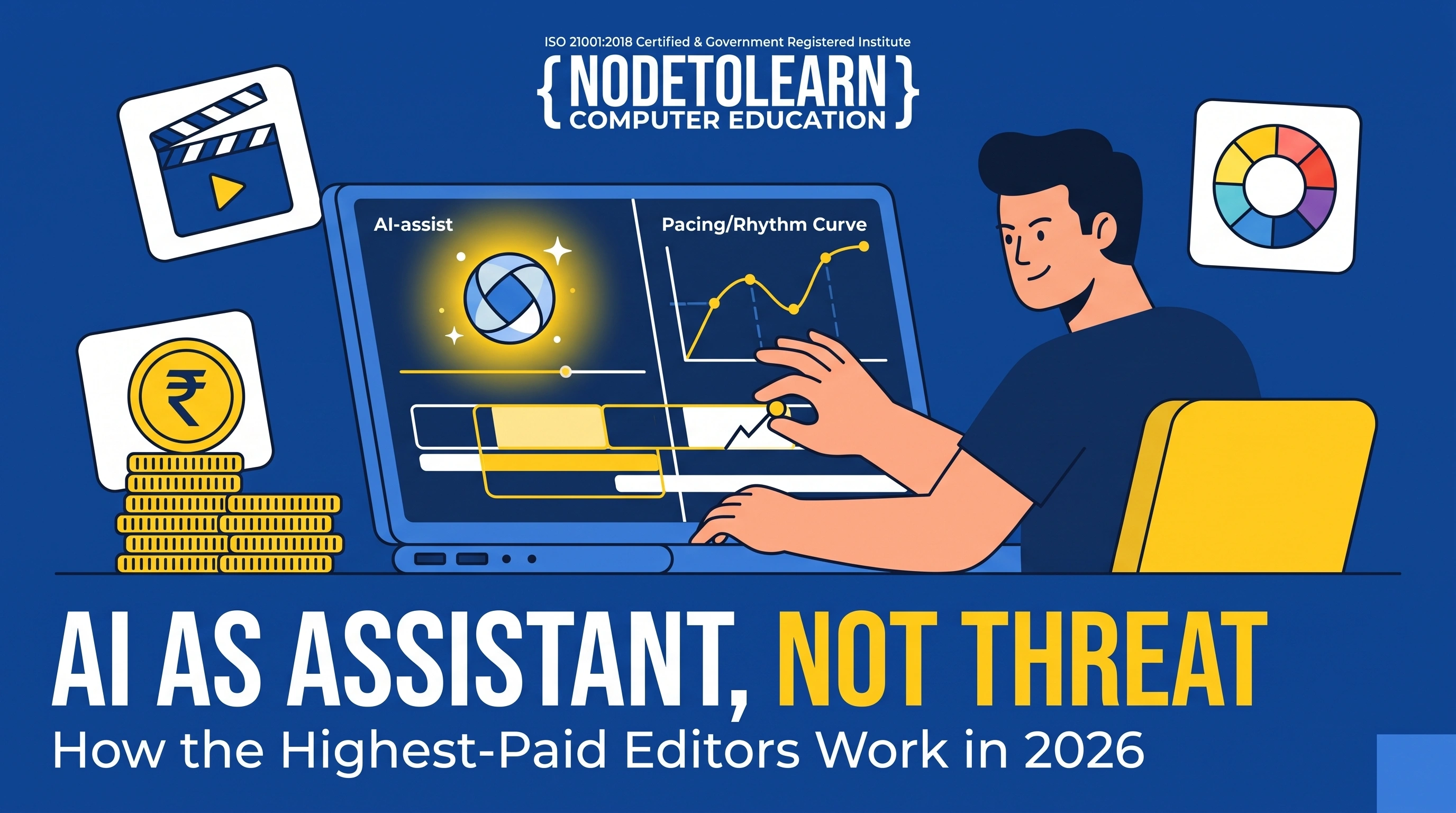
Quick Answer: The editors earning the most in 2026 aren't the ones avoiding AI tools out of fear, and they aren't the ones handing full creative control to AI either — they're the ones who've learned to treat AI as a fast, tireless assistant while keeping every real creative decision in their own hands. NodeToLearn's Video Editing course in Nanpura, Surat is built around exactly this balance, training editors who direct AI tools with intent rather than being replaced or ruled by them.
The Timeline Has Changed, But Not the Way People Feared
A few years ago, the fear in editing communities was simple: AI would eventually replace editors outright. That hasn't happened. What's happened instead is more interesting — the editing timeline itself has evolved. Rough cuts, captioning, basic color matching, and repetitive trims now often start with AI assistance. But the actual craft — pacing, emotional rhythm, storytelling structure — still requires a human editor who understands why a cut works, not just how to execute one.
Why Fear-Based Avoidance Is a Losing Strategy
Editors who refuse to use AI tools at all aren't protecting their craft — they're often just working slower than competitors who've integrated AI into their workflow. Clients and studios increasingly expect faster turnaround without sacrificing quality, and editors ignoring AI-assisted tools entirely are simply less competitive on speed, even if their final creative judgment is just as strong.
Why Full AI Dependence Is an Equally Losing Strategy
On the other end, editors who let AI make most of the creative decisions — pacing, cuts, tone — tend to produce work that feels generic and forgettable. AI is good at pattern-matching what's worked before; it's not good at knowing when to break that pattern for a specific emotional effect, which is exactly where skilled human editors still create the most value.
What the Highest-Paid Editors Are Actually Doing Differently
- Using AI for the mechanical layer — rough cuts, transcription, basic captioning — freeing up time for the creative layer that actually matters.
- Reviewing every AI suggestion critically — treating AI output as a first draft to refine, not a final decision to accept.
- Doubling down on storytelling skill — since the technical execution gap between editors has narrowed, creative judgment has become the real differentiator.
- Building a distinct creative voice — something AI-generated, pattern-matched edits inherently struggle to replicate consistently.
How NodeToLearn's Video Editing Course Reflects This Reality
The course is deliberately structured around both halves of this equation — real editing craft (pacing, color grading, audio design, storytelling) alongside practical AI-assisted workflow integration. Students learn to use AI to move faster on the mechanical parts of editing while building the creative judgment that actually determines whether an edit lands or falls flat.
Why This Balance Matters for Freelancers Specifically
Freelance editors competing for client work are increasingly judged on both speed and quality. An editor who can deliver AI-accelerated turnaround without sacrificing creative polish is positioned to take on more clients and command higher rates than one who's either too slow (avoiding AI entirely) or too generic (relying on it too heavily).
Will learning AI-assisted editing make my creative skills less valuable?
No — if anything, creative judgment becomes more valuable as AI handles more of the mechanical editing work, since storytelling and pacing decisions remain distinctly human strengths.
Should I avoid AI editing tools to protect my craft?
Avoiding AI tools entirely often just means working slower than competitors who use them for mechanical tasks while still applying strong creative judgment.
What editing skills still can't be replaced by AI?
Pacing, emotional storytelling decisions, and a distinct creative voice remain difficult for AI to replicate consistently, since these require contextual judgment rather than pattern-matching.
Does NodeToLearn's course teach both craft and AI tools together?
Yes, the course integrates core editing fundamentals with AI-assisted workflow tools, so students learn to use AI without losing creative control.
Does NodeToLearn offer a free demo for the Video Editing course?
Yes, a free 3-day demo is available so you can experience the teaching approach before enrolling.
Direct AI. Don't Depend On It.
Book your free 3-day demo at NodeToLearn Computer Education, Nanpura, Surat, and build editing skills that pay in the AI era.
Claim Your Free Trial


Frequently Asked Questions
Got questions? We've got answers. Explore everything you need to know about starting your tech career with NodeToLearn.
Still have questions?
Contact Our Team