

Google Search Ads vs. Meta Performance Marketing: Where Should a New Brand Spend Its First ₹10,000?
 Sep 30, 2026
•
 NodeToLearn Expert
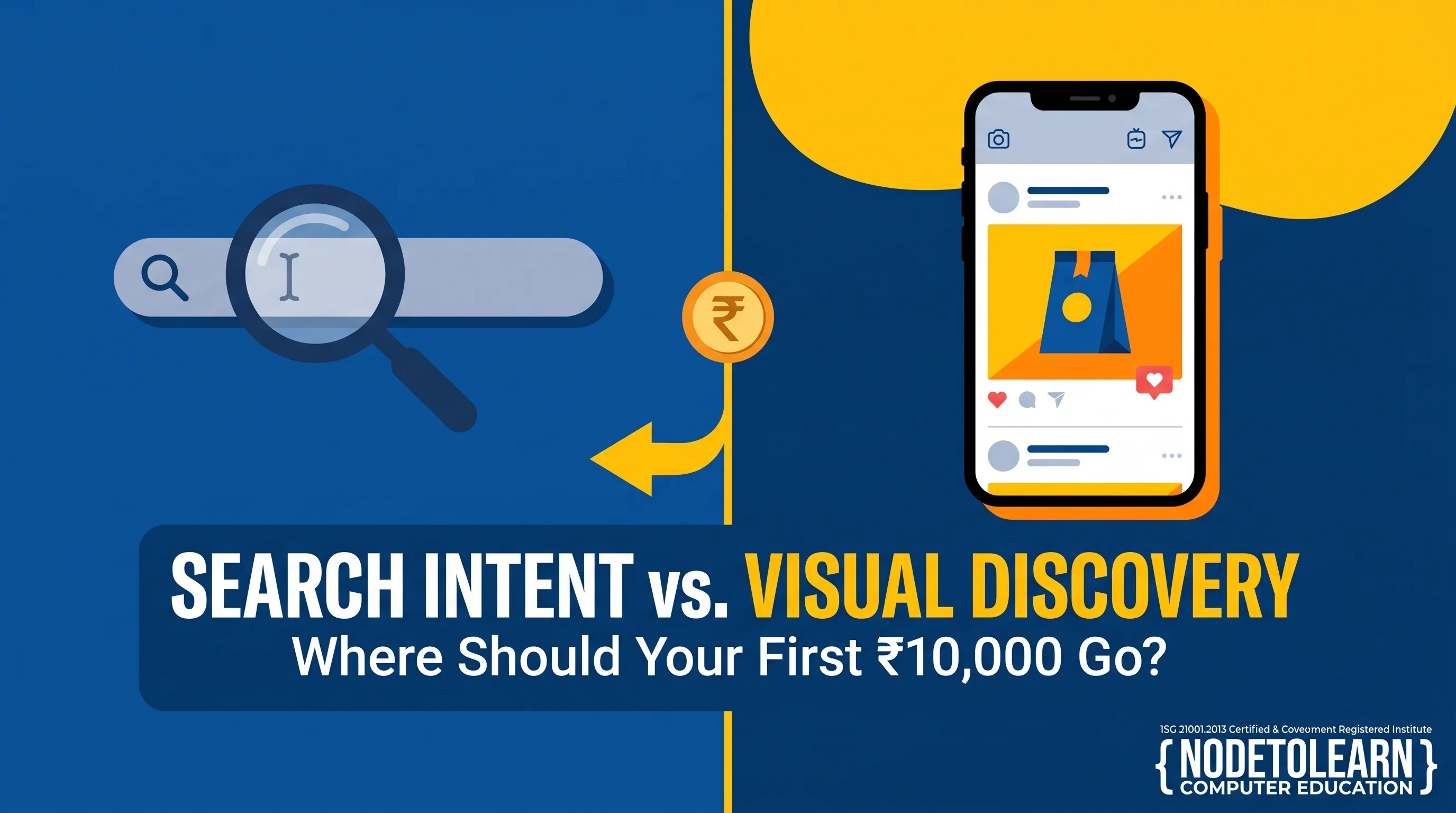
Quick Answer: There's no universal right answer — it depends on what you're selling. Google Search Ads capture people already searching for what you offer, which works well for established-demand products and services. Meta (Instagram/Facebook) ads create demand by showing your product to people who weren't actively looking, which suits visually appealing or discovery-driven products. A new brand with ₹10,000 should match the platform to their product type, not pick based on which platform is more talked about. NodeToLearn's Digital Marketing with AI course in Nanpura, Surat teaches this decision-making process, not just how to click "create campaign."
Why This Isn't a "Which Platform Is Better" Question
Google Search Ads and Meta ads solve fundamentally different problems. Search ads show up when someone is already looking for something — they have existing intent, and your ad just needs to win that moment. Meta ads interrupt someone's scroll to introduce them to something they weren't searching for — you're creating interest from zero, not capturing it. A small first budget spent on the wrong one for your product can underperform badly, regardless of how well the ad itself is made.
Side-by-Side: What Each Platform Does Well
| Factor | Google Search Ads | Meta Performance Marketing |
|---|---|---|
| Core strength | Capturing existing search intent | Creating demand through visual discovery |
| Best suited for | Products/services people actively search for (local services, specific needs) | Visually appealing products, impulse-friendly items, lifestyle brands |
| Ad format | Text-based, intent-driven | Image/video-based, scroll-stopping creative |
| Typical funnel stage | Bottom of funnel — ready-to-buy intent | Top/middle of funnel — awareness and interest building |
A Practical Way to Decide for Your First ₹10,000
- Ask: does my customer already know they need this? If yes (a local service, a specific product people search for by name), lean toward Search Ads.
- Ask: does my product sell itself visually? If yes (fashion, jewelry, home decor, food), lean toward Meta, where a strong visual can create desire someone didn't start with.
- Consider splitting cautiously, not evenly. With a limited first budget, a small, deliberate test on one platform with a clear hypothesis usually teaches you more than spreading thin across both.
- Track what actually converts, not just clicks. A cheap click that never buys is worse than a more expensive click that does — first-budget testing should measure actual outcomes, not vanity metrics.
Why Surat Businesses Specifically Should Think This Through
Surat's textile, jewelry, and fashion-adjacent businesses often have genuinely strong visual products — a natural fit for Meta's discovery-driven format. Service-based businesses (classes, repair services, local professionals) usually see stronger results from Search Ads, since customers are already typing in what they need. Getting this match right before spending matters more than the platform's reputation.
A Note on Costs
Ad costs and minimum effective budgets change frequently and vary by industry, competition, and targeting — treat any fixed number you read online as outdated the moment it's published. The right approach with a first budget is to start small, measure results directly in your own ad account, and adjust from real data rather than a generic rule of thumb.
Is ₹10,000 enough to actually learn something from a first ad campaign?
It can be enough for a focused, well-targeted test, especially if you track conversions carefully rather than spreading the budget too thin across multiple audiences or products.
Should I ever run both Google and Meta ads at the same time with a small budget?
With a very limited first budget, it's often more useful to test one platform properly first rather than splitting too thin to draw a clear conclusion from either.
Does NodeToLearn's Digital Marketing course cover both platforms?
Yes, the Digital Marketing with AI course covers Google Ads, Meta/social advertising, and the decision-making process for choosing the right platform for a given product or service.
Does NodeToLearn offer a free demo for this course?
Yes, a free 3-day demo is available so you can experience the teaching approach before enrolling.
Learn to Match the Platform to the Product, Not Just Run Ads
Book your free 3-day demo at NodeToLearn Computer Education, Nanpura, Surat, and learn to spend your first marketing rupee wisely.
Claim Your Free Trial


Frequently Asked Questions
Got questions? We've got answers. Explore everything you need to know about starting your tech career with NodeToLearn.
Still have questions?
Contact Our Team