

Generative Engine Optimization (GEO) vs. Traditional SEO: Ranking Brands on AI Search Agents in 2026
 Jul 29, 2026
•
Jul 29, 2026
•
 NodeToLearn Expert
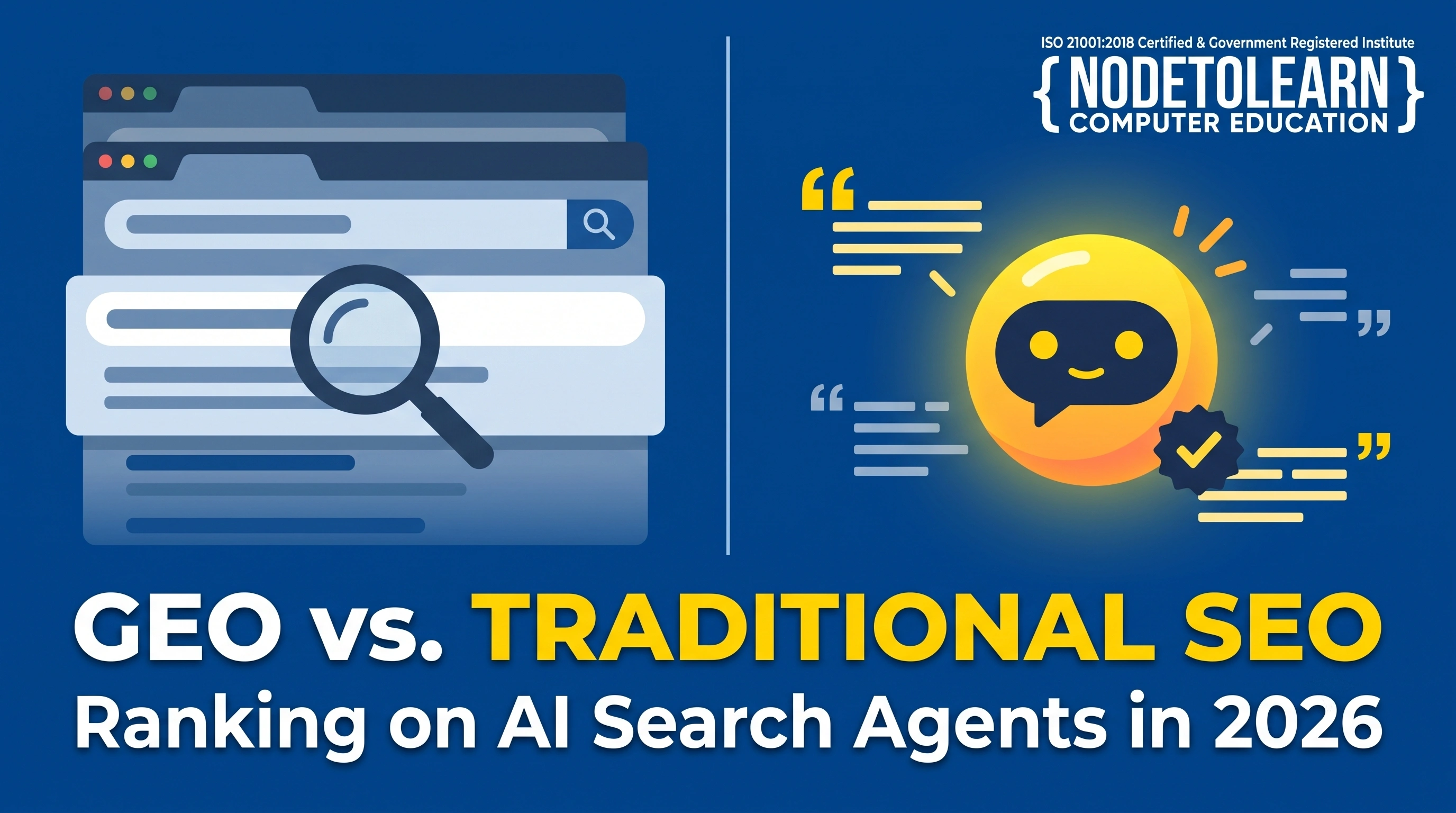
Quick Answer: Generative Engine Optimization (GEO) is the practice of optimizing content so AI systems like Google AI Overviews, ChatGPT, and Perplexity cite and recommend your brand directly in their answers — a different discipline from traditional SEO, which focuses on ranking in a list of blue links. In 2026, brands need both. NodeToLearn's Digital Marketing course in Nanpura, Surat now teaches GEO alongside traditional SEO, because ranking on a results page and getting cited inside an AI answer have become two separate, equally important battles.
Why This Distinction Suddenly Matters
For two decades, "ranking" meant one thing: showing up on page one of Google's list of links. That's changing. A growing share of searches now get answered directly by AI-generated summaries — Google's AI Overviews, ChatGPT, Perplexity, and similar tools — often without the user ever clicking through to a website. If your content isn't structured in a way these systems can understand, extract, and trust, you can be "ranking" in the traditional sense while becoming invisible in the answers people actually see.
Traditional SEO vs. GEO: What Actually Changes
| Factor | Traditional SEO | GEO |
|---|---|---|
| Goal | Rank in the list of search results | Get cited or summarized inside an AI-generated answer |
| Content structure | Keyword-optimized pages, backlinks, page speed | Clear, direct answers; structured Q&A; quotable statements |
| Success signal | Click-through rate, ranking position | Being quoted, summarized, or referenced by an AI system |
| Key ranking factors | Backlinks, domain authority, on-page keywords | Clarity, factual accuracy, structured data, topical authority |
What Actually Helps Content Get Picked Up by AI Search Agents
- Direct, quotable answers early in the content — AI systems favor content that states a clear fact or answer in the first few sentences, not buried after a long introduction.
- FAQ-style structure — question-and-answer formatting is easy for AI systems to extract and cite directly.
- Structured data (schema markup) — helping search engines and AI crawlers understand exactly what a page is about.
- Genuine topical authority — consistent, accurate content on a subject over time, rather than a single one-off page trying to rank for everything.
- Credibility signals — clear sourcing, verifiable claims, and author/organization trust markers, since AI systems are increasingly cautious about what they cite.
Why Local Businesses in Surat Can't Ignore This
When someone in Surat asks an AI assistant "best computer classes near me" or "which accounting course should I take," the answer that gets generated pulls from content structured for exactly this kind of extraction. Businesses still optimizing purely for traditional keyword rankings risk becoming invisible in a growing share of these AI-mediated searches — even while their traditional SEO metrics look fine.
What NodeToLearn's Digital Marketing Course Now Covers
Given how fast this shift is happening, NodeToLearn's Digital Marketing with AI course has expanded to include GEO alongside traditional SEO — teaching students how to structure content, build topical authority, and write in a way that both search engines and AI answer engines can trust and cite. Students learn to future-proof marketing skills rather than optimize for a system that's already evolving past them.
Does GEO replace traditional SEO, or work alongside it?
GEO works alongside traditional SEO rather than replacing it. Traditional search rankings still matter, but GEO addresses the separate, growing challenge of being cited directly in AI-generated answers.
Can a small local business realistically compete for GEO visibility?
Yes. GEO rewards clarity, structured content, and genuine topical authority more than sheer domain size, which means well-structured local content can compete effectively against larger, less focused competitors.
Do I need technical skills to learn GEO?
Basic familiarity with content structure and schema markup helps, but the course teaches these concepts progressively, making it accessible to marketers without a deep technical background.
Is Digital Marketing with GEO training part of a separate course, or included in the main Digital Marketing course?
GEO is taught as part of NodeToLearn's Digital Marketing with AI course, alongside traditional SEO, social media marketing, and content strategy.
Does NodeToLearn offer a free demo for this course?
Yes, a free 3-day demo is available so you can experience the teaching approach before enrolling.
Stop Optimizing for a Search Engine That's Already Changing
Book your free 3-day demo at NodeToLearn Computer Education, Nanpura, Surat, and learn marketing skills built for where search is actually headed.
Claim Your Free Trial


Frequently Asked Questions
Got questions? We've got answers. Explore everything you need to know about starting your tech career with NodeToLearn.
Still have questions?
Contact Our Team