
Frontend vs. Backend vs. Full-Stack: Which Path Actually Lands Jobs Faster?
 Sep 29, 2026
•
 NodeToLearn Expert
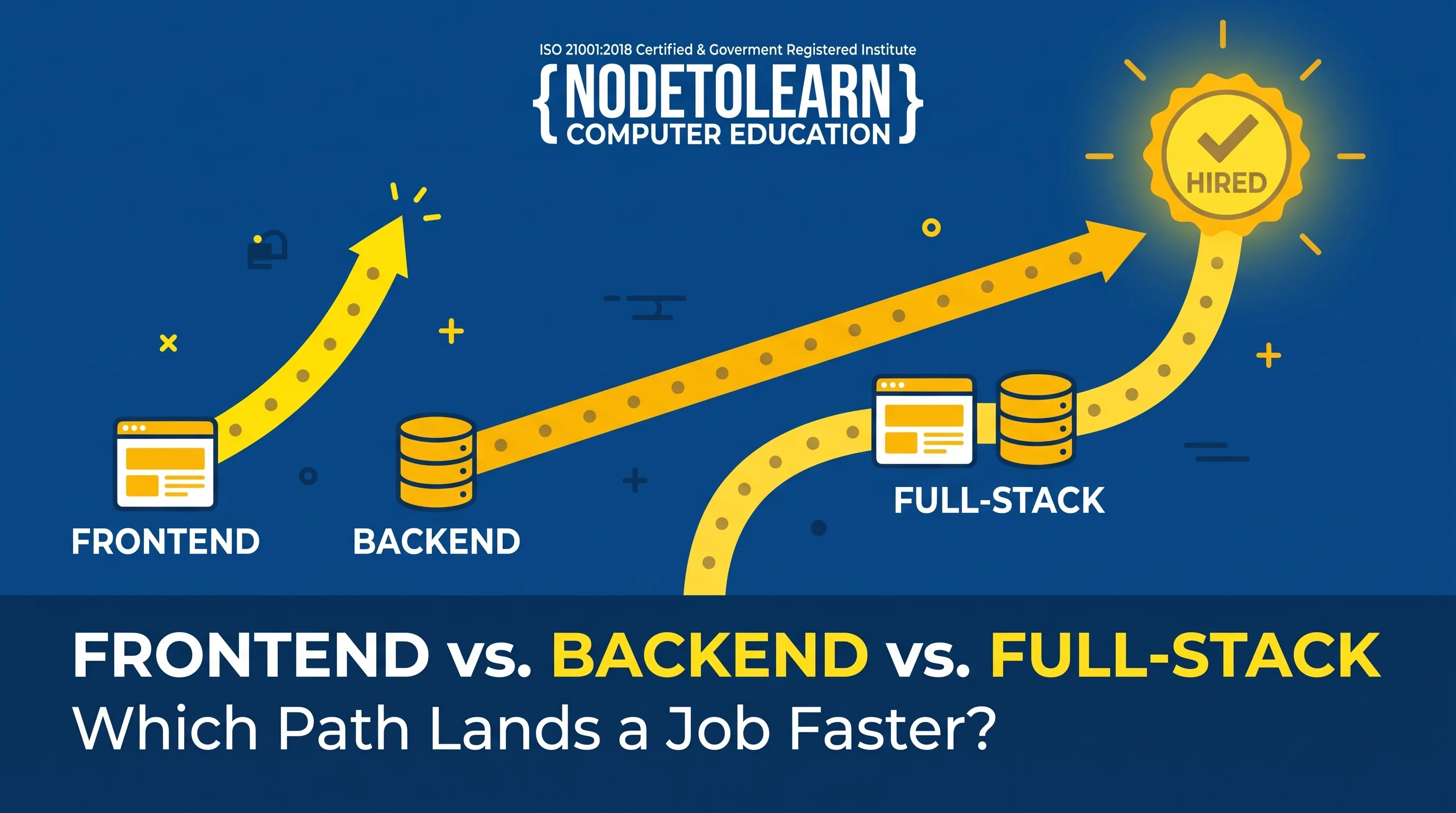
Quick Answer: Frontend development tends to have the lowest barrier to a first job because the learning curve is shorter and entry-level openings are common. Backend roles often pay more once you land one, but usually expect a bit more depth before you're job-ready. Full-stack sits in between — takes longer to learn properly, but makes you eligible for the widest range of job postings, since many companies now hire full-stack by default. NodeToLearn's Nanpura campus teaches all three paths through 1-on-1 mentorship, so the choice can be based on your actual timeline and goals.
Why "Which Is Faster" Isn't the Same as "Which Is Better"
Speed to a first job and long-term career strength aren't the same question. A path that gets you hired in three months isn't automatically the smartest long-term choice, and a path that takes longer isn't automatically the best one either. This comparison is specifically about time-to-first-job, not which path is objectively superior.
Side-by-Side Comparison
| Factor | Frontend | Backend | Full-Stack |
|---|---|---|---|
| Typical learning curve | Shorter — visual feedback makes progress feel faster | Steeper — more abstract concepts before results are visible | Longest — covers both sides properly |
| Entry-level job volume | Generally higher, especially at smaller companies and agencies | Fewer pure entry-level backend-only roles | Increasingly common as many companies hire full-stack for small teams |
| Portfolio speed | Fast — a working, visible project can be built quickly | Slower — backend work is less immediately visible/demoable | Moderate — a smaller full app is achievable, just takes longer |
| Ceiling once hired | Good, with specialization (e.g., performance, animation) | Often strong, especially with system design depth | Broadest — flexible across roles and smaller teams/startups |
Frontend: Fastest Visible Progress
Frontend development (HTML, CSS, JavaScript, React) tends to be the fastest path to a demoable project, because you can see what you're building as you build it. That visible feedback loop keeps motivation high and makes portfolio-building relatively quick — a real advantage when trying to land a first job.
Backend: Slower Start, Often Stronger Pay Ceiling
Backend development (Node.js, databases, APIs) has less immediate visual payoff, which can make the early learning phase feel slower and less rewarding. But backend roles, particularly with strong system design and database skills, often carry a higher pay ceiling once you're in — the depth required to learn it is also part of why it's valued more once you have it.
Full-Stack: Longer to Learn, Widest Net of Opportunities
Full-stack development (MERN, MEAN) takes the longest to learn properly, since it covers both frontend and backend fundamentals. But it also makes you eligible for the largest pool of job postings, since many startups and small teams specifically want one person who can handle an entire feature end-to-end, rather than hiring two specialists.
What Actually Speeds Up Any of These Paths
- Real project work, not just tutorials. A demoable project you built yourself matters far more in interviews than a list of completed courses.
- 1-on-1 feedback that catches bad habits early. Self-taught developers often carry small misunderstandings for months because nobody corrected them — a mentor catches this immediately.
- Focus over spreading thin. Trying to learn all three paths at once, unfocused, is usually slower than committing to one and going deep first.
How NodeToLearn Helps You Choose
NodeToLearn teaches Website Designing (HTML/CSS/JS) and frontend-focused tracks, backend fundamentals within MERN/MEAN, and full-stack development end-to-end — all through 1-on-1 mentorship. Rather than guessing which path fits your timeline and goals, mentors help you decide during the free demo based on where you're actually starting from.
Is frontend really the fastest way to get a first developer job?
It's often the fastest to a demoable project and has a relatively high volume of entry-level openings, though actual hiring speed still depends on your portfolio quality and local job market.
Should I start with full-stack if I'm not sure which path to specialize in?
It's a reasonable option since it exposes you to both sides before you decide where to go deeper, though it takes longer to reach job-ready than focusing on frontend or backend alone.
Does backend really pay more than frontend?
This varies by company and region, but backend and full-stack roles with strong system design skills often command higher pay ceilings, while frontend specialists can also earn well with strong performance and UI expertise.
Does NodeToLearn offer a free demo to help me choose?
Yes, a free 3-day demo is available, and mentors can help you evaluate which path fits your timeline and goals before you commit.
Not Sure Which Path Fits Your Timeline?
Book your free 3-day demo at NodeToLearn Computer Education, Nanpura, Surat, and get 1-on-1 guidance choosing frontend, backend, or full-stack.
Claim Your Free Trial


Frequently Asked Questions
Got questions? We've got answers. Explore everything you need to know about starting your tech career with NodeToLearn.
Still have questions?
Contact Our Team