

Beyond the Chatbox: Why 2026 Belongs to Agentic AI, Not Prompt Engineering
 Sep 16, 2026
•
Sep 16, 2026
•
 NodeToLearn Expert
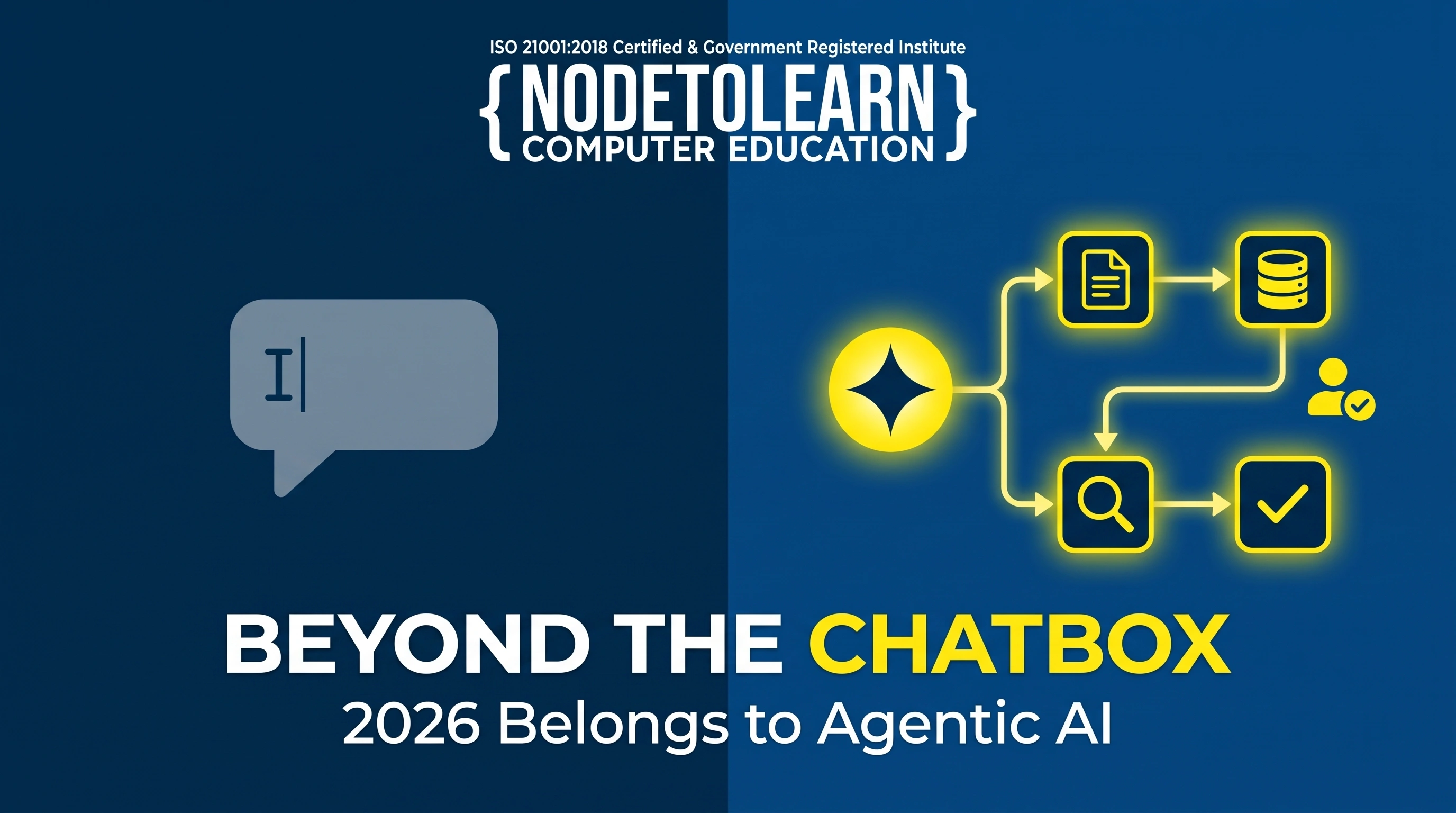
Quick Answer: Prompt engineering — crafting the perfect instruction for a chatbot — was the defining AI skill of the early 2020s. In 2026, the more valuable skill is agentic AI: designing systems that plan and execute multi-step tasks using tools, with minimal step-by-step supervision. Prompting hasn't become useless, but it's become table stakes. NodeToLearn's Generative AI & Agentic Systems and Agentic Workflow Automation courses in Nanpura, Surat teach the layer that actually differentiates people now.
Why Prompt Engineering Stopped Being a Differentiator
A few years ago, knowing how to phrase a request well genuinely produced dramatically better AI output than a careless prompt. Two things changed that. First, AI models got significantly better at understanding intent from ordinary, unpolished instructions. Second, millions of people learned basic prompting — it's now a widely distributed skill rather than a rare one. A skill that everyone has isn't a competitive advantage, no matter how useful it remains.
What Agentic AI Actually Changes
Prompt engineering operates inside a single exchange: you ask, the AI responds, you evaluate, you ask again. Agentic systems operate across many steps: given a goal, the system decides what steps are needed, uses tools to execute them, checks its own progress, and adjusts along the way. The difference isn't incremental — it's the difference between using a very capable assistant one instruction at a time, and delegating an entire outcome.
| Factor | Prompt Engineering | Agentic AI |
|---|---|---|
| Scope | Single request and response | Multi-step task completion toward a goal |
| Human involvement | Every step requires a new instruction | Human sets the goal and reviews; system handles the steps |
| Core skill | Writing clear instructions | Designing workflows, tool access, and guardrails |
| Who has it | Widely distributed now | Still comparatively rare |
What the Agentic Skill Set Actually Involves
- Workflow decomposition — breaking a real goal into steps a system can reliably execute, which is a design skill more than a writing skill.
- Tool integration — connecting an agent to real data sources and systems so it can take action, not just produce text about taking action.
- Guardrails and oversight design — deciding where autonomy is appropriate and where a human must approve, which matters enormously once a system can act rather than just suggest.
- Failure handling — building systems that behave sensibly when a step fails, rather than confidently continuing down a broken path.
An Honest Caveat Worth Stating
Agentic AI is genuinely powerful, but it's also less mature than the hype sometimes suggests — autonomous systems still fail in ways that require human judgment to catch, and giving a system real tool access raises real security and oversight questions. That's precisely why the skill in demand isn't "deploy agents everywhere," but rather knowing where agentic autonomy actually works, where it doesn't, and how to build sensible limits around it. Anyone teaching this without covering the failure modes is teaching half the subject.
How NodeToLearn Teaches This Layer
NodeToLearn's Generative AI & Agentic Systems course covers building with generative models and designing autonomous multi-step workflows, while Agentic Workflow Automation focuses on practical automation building. Both are taught 1-on-1 with real project work — including the unglamorous but essential parts: reviewing what an agent actually did, catching where it went wrong, and building guardrails that hold up in practice.
Is prompt engineering now a useless skill?
No — clear prompting remains genuinely useful and is part of building agentic systems too. It's simply no longer a differentiator on its own, since it's become a widely held skill rather than a rare one.
What's a practical example of an agentic system?
A system given the goal of preparing a weekly report that independently gathers data from connected sources, drafts the report, checks it against the source data, and flags anything uncertain for human review — completing many steps from one instruction.
Do I need programming experience to learn agentic AI?
Basic programming familiarity helps for more advanced workflow building, though foundational concepts are taught progressively for students newer to programming.
Which NodeToLearn course should I take for this?
Generative AI & Agentic Systems suits students wanting to build agentic systems from the ground up, while Agentic Workflow Automation focuses on practical automation building. Mentors can help you choose during the free demo.
Does NodeToLearn offer a free demo for these courses?
Yes, a free 3-day demo is available so you can experience the teaching approach before enrolling.
Stop Competing on a Skill Everyone Already Has
Book your free 3-day demo at NodeToLearn Computer Education, Nanpura, Surat, and learn to build agentic AI systems, not just prompt them.
Claim Your Free Trial


Frequently Asked Questions
Got questions? We've got answers. Explore everything you need to know about starting your tech career with NodeToLearn.
Still have questions?
Contact Our Team